Friday, 1 November 2013

Limmy's Lookout

For those of you who know the Arlington Estate well, you may have seen a small hut appear hidden within the gardens.

Murray first had his vision for this hut in 2012. He wanted to create a wooden structure that would blend in well within the gardens which could be chanced upon by visitors as they walked through the grounds where they could sit and enjoy the views accross the parkland.

The first phase of the project was in the winter of 2012 when with the help of a working holiday group we cleared the area of bramble and removed any trees that needed to come out. We then quickly followed this up by the planting of bluebell bulbs amongst the trees.

We wanted to use wood from the estate and decided to create the main frame out of sweet chestnut. So Stuart and I were sent to Cott wood for a day felling, cutting, bark peeling and hauling back long and very heavy lengths of sweet chestnut. Murray set to work building the roof frame and by the end of the winter we were all set to start. However due to time constraints and Stuart and I getting carried away on Monkey Puzzle Mania, no further work was done on the hut in till summer this year.

We decided to utilise the help of our working holiday groups this summer and began by putting in our main structure in July.


The hut quickly took shape and the phrase, many hands make light work, never rang more true. By the end of the two weeks with our working holidays the main structure was up, the roof on, floor in and our walls had begun to take shape.


For the floor we used large rounds of monkey puzzle wood from a tree which had been taken down by the lake and sweet chestnut logs to fill the gaps. We also decided to use sweet chestnut for the walls, all of which was from Cott Wood.
Hours and hours of chainsawing was involved to create enough log rounds for walls and I am sure our seasonal Ranger Rich would tell you he would never want to cut another log again in his life!

Work began on the path to the hut, it was decided to be a wooden path winding its way to the hut. I must say I was very skeptical about how long this would take us but I am very glad it was created because it is absolutely beautiful. Our contractor Dennis first dug us a path with his mini digger and then we lay in large log rounds with smaller log rounds along the edge. Each log had to be tamped down and made as level as possible. We then back filled with soil, tamping as we went and finished with a stone dressing on the surface.


And for the final phase with our final working holiday we created the green roof and walls, As we had built the walls we had deliberately left small gaps so that we could plant ferns into the walls. A double layer of turf was used on the roof and ferns were also planted into the turf.

The finished product

This project took us hours of time and without all the volunteer hours put in by our working holidays and our own volunteers we would still be working on it now. What began as only as vision by Murray is now a beautiful structure.
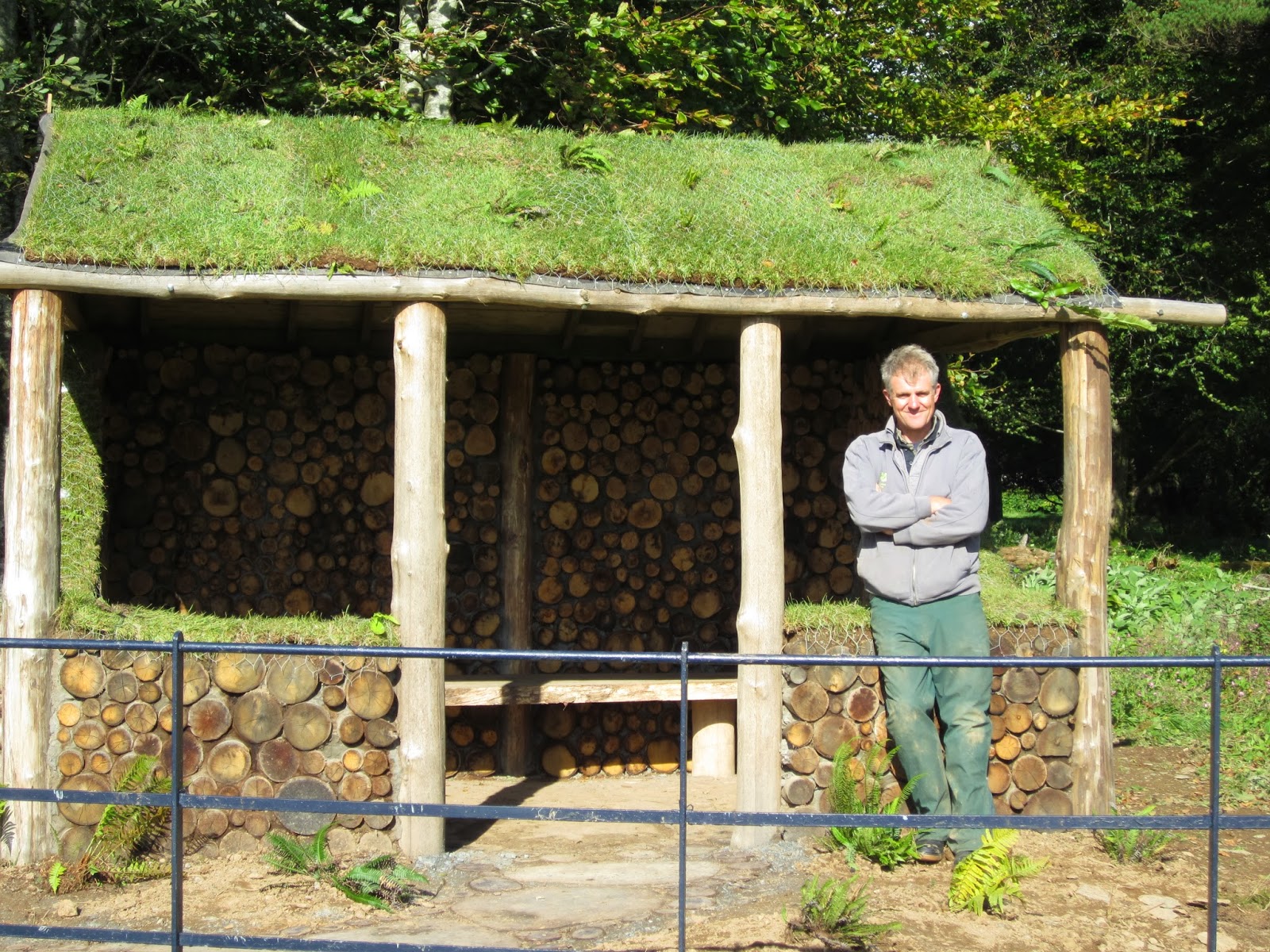
A very pleased Murray Sharpe with his completed hut

The hut can now be a place for people to sit and enjoy the view for a quick rest or a long lunch. I even manged to squeeze 22 school children in the hut recently so they could all draw the view.

We struggled and debated with the right name for the hut for a while and it did become the Woodman's Hovel for a while. However due to a sad turn of events in which our oldest cow failed her TB test, it was suggested by Natalie (Visitor Services Manager) that it should be named after Limmy who has been at Arlington and looked after by Murray for the past 9 years. So our hut is now know as Limmy's Lookout and hopefully will go someway to preserving her in our memories.

So next time you are here at Arlington search for Limmy's Lookout and spend a few minutes relaxing and enjoying the views out accross the parkland.


Wednesday, 25 September 2013

Meet Limmy

Meet Limmy our Red Devon x Limousin cow.


Limmy ended up in our herd more by accident than planning. When Murray was setting up our herd of Red Devon cattle he asked a local farmer to buy some pedigree Red Devon's at a local sale and she was one of the cows who was brought back.

Limmy is now 11 years old and has had 9 calves with us here. Her calves always finish off on grass well and one of her offspring is now in the herd as a breeding cow.


Limmy with her newly born 9th calf, earlier this year.


Limmy is not the biggest in the herd yet she is the leader of the pack. Cows have a hierarchy structure within the herd with the young heifers tending to be a the bottom and the older larger cows at the top. You often see them having a scuffle amongst themselves which is their way of showing their dominance over one another.

Since I started here a year ago Limmy has become my favourite cow due to her friendly nature and leadership qualities.
We often move our cows through the estate by calling them and walking them along the forest tracks to their new field. This approach is very stress free for our cattle and we also get to enjoy a walk through part of the estate.


The older cows are invaluable when we move them due to the fact that they often remember where they are are heading on a particular track and therefore they help to lead the younger herd members to the new fields.
Limmy's leadership qualities are essential when we are moving the cows and they make our lives a lot easier, she is always the first to hear your call, and the first in line to leave the field. In the photo below Limmy demonstrates her patience due to the fact she had responded to my call much quicker than the others and she had to wait for 10 minutes at the gate while the others crossed the stream and came up the bank. The whole time she stood at the gate waiting for it to be opened where as normally a cow would have become bored and impatient and walked off.


Limmy always has a spare time for you and often enjoys a scratch when you go to check on the cows. Limmy has easily become my favourite cow in the herd due to her friendly nature and I enjoy nothing more than spending a moment with her everyday.


Me and Limmy saying a quick hello while her calf watches on


1/11/13

With much sadness I must share the news that Limmy failed her TB test last week and therefore will be leaving us here at Arlington. She will be forever remembered by Murray and I.


Tuesday, 23 July 2013

Arlington School Spy Day

As a Ranger team we have spent a significant amount of time creating a schools program, so that school groups can choose from a list of sessions we run. We have created varied sessions for a variety of ages including habitat and natural art days.

We have also created a day known as our wild play day, the sessions enable children to fully understand what the outdoors can offer them in a series of fun cross curricular play sessions.

Last week we got the chance to do Arlington Spy School with Shirwell Primary School. Shirwell also came and spent a day with us last month doing our music day, they were even subjected to our now infamous 'Sheep Rap'  and therefore we knew we had to really pull out all the stops to impress them again at Spy School.

Steve and I decided to get into character for the day which involved us getting agent T- shirts and camouflage face paint. We decided to create agent names based on British wildlife; Agent Shrew, Agent Dormouse and Agent Otter.


Shirwell School soon settled in when they arrived having themselves adorned with camouflage face paint as they were introduced to spy school and instructed that they were now training to be top Arlington agents.

The spy school morning session is designed to teach the students skills they will need in the afternoon surprise challenge. They were split into three groups and each group three sessions. One being an assault course designed to improve their team work. A map drawing exercise which will teach them to draw and use a map by following directional arrows. And the third exercise is to create a 'secret' trail using sticks and stone to mark the way.

Following a successful morning session the trainee agents were then informed that they had a written exam for the afternoon to prove their agent skills. However as they are being set up for their exam an emergency call over the radio came through from Agent Otter; He has been captured by the evil Dr Worm!

Agent Shrew and Agent Dormouse told the trainee agents that they will have to assist with the rescue. The Trainee agents are organised into six groups and given their mission packs to help lead them around a  pre laid trail guiding them to Agent Otter. Each group had a teacher as a leader and they are all started at different locations on the clue trail.

All the groups got into the competitive spirit especially Mr Allen's (Shirwell's Headteacher) group who were seen leaping over flower beds. The groups completed the trail following clues and collected letters to gain access to Agent Otter's final location. The first group managed to complete the trail within 30 minutes and rushed down to find Agent Otter who had been tied up by Dr Worm in the Wilderness.


Each group was allowed to find Agent Otter and then went back up to wait for all the groups to complete the trail. Following completion of the challenge each student was awarded with Arlington Spy School pass certificate with their own secret agent name.

All the students went home in high spirits from their day of spy school training. Steve and I were also very happy that the day went so well but exhausted from an extremely busy day. And we packed away our shirts untill the next school books on the Arlington Spy School Day.


Monday, 24 June 2013

Beyoncé our Red Devon Heifer


Just over two months ago we had our annual TB test. For the first time in ten years we have had a TB reactor.

He was a one of our two year old steers, although this was heartbreaking I drew a positive from the fact it was not a breeding cow, or a young heifer.

However last week we had our first sixty day test and another two of our cattle reacted. A steer and a three year old heifer Beyoncé.

Beyoncé gained her name from her highlighted hair and diva attitude. She did everything her own way and in her own time. If you tried to move her she would lean against you, as if you were scratching her. Cows are naturally herd animals but not Beyoncé, if she didn't want to move she would happily remain in the field by herself. On one particular occasion she caused our heart rates to soar when she decided not to go into her new field preferring the main road instead.

Beyonce often caused others to follow her lead, creating much frustration, especially to myself and Murray as we would watch the herd run in the wrong direction with their tails in the air. Despite this I cannot help but hold great respect for her independence and spirit.

So when I came to load her into the cattle box for her final trip with us, I was not surprised by her usual stubbornness (and this I time could not blame her!). Yet when we unloaded her into the slaughter mans lorry she seemed to except her fate and walk straight in. I watched with a heavy heart and a lump in my throat.

I struggled to think of a single positive this time, Beyoncé was one cow who will never reach her full potential as a breeding cow in the Arlington herd.

All over the country farmers are loosing their Beyoncé's to TB and it is heart wrenching to watch your stock being taken to their untimely death.

I write this so that I can share a small aspect of the reality of emotional ups and downs of working with livestock.

Beyonce also deserves more than just my goodbye.


Monday, 20 May 2013

Pizza Oven Rebuild

We have had a pizza oven in the Wilderness Hideaway for a few years now but as you can see it was in need of a rebuild.

The first problem was finding enough time to put aside to building the oven as I needed 3 days within a week when I was free - I settled on the May bank holiday weekend as the perfect time due to the glorious weather and some keen volunteers.

My first job was to destroy our current oven. The oven had slowly been degrading in the rain due to the fact the parachute had been down for a vast majority of the winter while tree surgery work took place.

Old Pizza Oven

Luckily on the first day Stuart who had built the first oven returned from National Trust Woolacombe to help me out for the day.

The first stage after levelling our base was to build a sand dome. This was built on top of some previously laid fire bricks.


Once the sand dome had been created (this took four bags of red builders sand) you then need to lay wet newspaper on top of the dome. This is so that when you dig out the sand from under the clay layer you know when to stop digging!

Now is the time to get your feet muddy, we did a mixture of two parts sand to one part clay. We laid out a piece of tarpaulin and added our mixture on top and then slowly added water and paddled the mixture with our feet in till it was the right consistency.


It is good at this point to have lots of helpers to speed the process up. Once the mixture was as desired, you then start to make 'bricks' out of the clay and build up around the sand dome. The way I judged the mixture was to create a ball of clay and drop it down and if it held its shape then it was the right consistency.


Building up our first layer

Once the dome is completed it must be left to dry out a little - I left ours over night.
The next day I returned to add on an insulating layer, this is the same ratio of sand and clay but with straw added in for insulation and here I am enjoying getting messy again.


Just before I added the insulating layer on I cut out the door and the chimney - I found the correct calculations for the door height and width online.
Once I was happy that the door was correct I started to add the next layer on - using the same method as before by creating them into bricks and building the pizza oven up.


Once the second layer was complete; this also had a days drying time before I came back to do the third and final layer. I put the third and final layer on with a sand and clay mix. I added some detail to my final layer to create a mystery creature.


All we now have to do is start the drying out process by lighting a very small fire within the oven and slowly drying out the clay. I will try and light a fire in the oven everyday for a week and slowly build the fire's size up each time. By being patient I hope to make sure I do not create any cracks and slowly prepare it for a busy summer season of pizza cooking for our visiting school groups and our Wild Wednesday and Fun Fridays sessions.
Having had my first experience of building a pizza oven I  am now inspired to build myself one at home.

Please feel free to ask any questions if you also would like to have a go, I am happy to give you more detail.

Holly Purdey

Ranger

Thursday, 16 May 2013

Just thought I would give you a little background to the Arlington farm sheep.

There have been sheep at Arlington for many years and our existing Jacob flock are descendants of Miss Chichesters own sheep that she gave to the NT when she gave Arlington in 1949. At present we have 63 breeding ewes all of which are pedigree Jacobs. We mated them in November to two of our rams. The legend Dirk the Dorset ram got most of the ewes. The idea is that Dorset cross lambs fatten a lot faster than pure Jacob lambs.
Ken our Pure Jacob ram got the rest and the few lambs produced by this small number of ewes should give us enough pure Jacob ewe lambs to replace some of our older ewes. This means we do not have to buy any in. Ken has been with us for several years so we have just purchased a new ram to replace him.

Usain is our new ram from the Dalewode flock in East Devon. Its a very good flock with many champions so we are looking forward to some excellent lambs in 2014.

The sheep are used to graze in the park and some of the smaller grasslands around the estate. They keep the sward open and will eat some of the bramble. Sheep are a little un-selective in the way they graze meaning that they can graze out wild flowers if not carefully managed.

Murray Sharpe Outdoor Manager.


Usain


Ken

Dirk


Saturday, 4 May 2013

Worming time for our Sheep

Worms are internal parasites in sheep and worming is vital to keeping our sheep flock healthy. Worms can cause a variety of problems including weight loss, diarrhoea, coughing and general unthriftiness. We use a combinex sheep wormer for our sheep.

Worming involves getting our sheep into our sheep pens and running them all through the sheep race recording their indivdual tag number as they get their dose of wormer. We must record their tags numbers to record it all in our stock book. This is very important as once a sheep has been given a wormer than they must not be entered into the human food chain for a set period of time, in our case combinex withdrawal period is 56 days.


We use a drenching gun to adminster our wormer. This is very important due to the fact that the amount of wormer given is based on the sheeps weight and therefore having a drenching gun ensures the correct amount is given due to the fact you can calibrate the number of mls given.

We have had wonderful hot weather this week and although I will not complain, this did make it rather hot work for working with the livestock and I have finished this week feeling battered and bruised after being pushed around by our sheep.

I ended up standing in the sheep races as they went through as I found it was the most efficent way but this did mean that the sheep were constanly bashing the back of my legs. One particuly lively lamb decided to headbutt my shin with its newly growing horns which caused a lot more pain then I was expecting from a tiny lamb.

However once they were all out in the field and enjoying the sun again I could not help but forgive them.


Holly Purdey

Ranger